Every single piece of writing has a bigger story behind it. ‘How I wrote it’ yanks back the curtain on the creative process, exploring how writers turn their musings into finished work. I’ll go first …
Braying for Love, Australian Geographic, Nov-Dec 2023
What sparked the initial idea?
I’m on Tourism and Events Queensland’s (TEQ) media mailing list which regularly highlights new product in the state. The ‘Packer’s Ghost Trek’ was described in a few lines in one of these emails in 2021 – and the name of alone intrigued me. Wanting to know more, I reached out to the tour operator, who passed me onto the route designer and trek leader Tim Daniel.
Travel writers embark on lots of tours. What made this one so compelling?
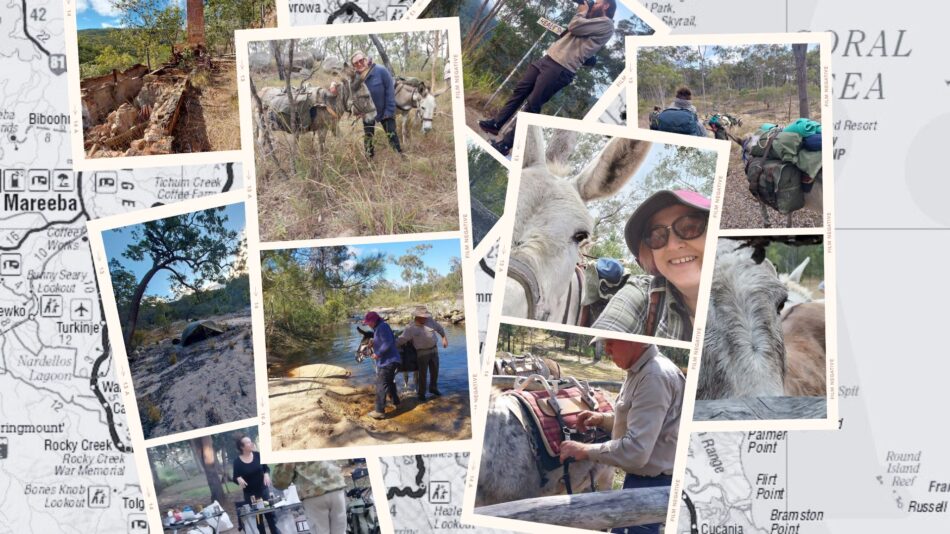
During my chats with Tim, I learned that the multi-day trek involved leading donkeys through hinterland 90 kilometres south-west of Cairns. The donkeys were there to carry our camping gear but also to create a more authentic way to re-experience the lives of the packers and drivers of the thousands of horses and mules that travelled these routes between 1872 and the turn of the century. (To read more on why travel writing doesn’t always involve five-star hotel stays, read 13 truths and 1 lie about being a travel writer.)
I was also drawn in by Tim’s deep passion for Far North Queensland (FNQ) history, his respect for the early pioneers who eked out a living in this tough environment, and his interest in the packing teams that supported the development of the region’s mining towns. This story had everything – history, culture, and adventure. Adding to the appeal was that this trek hadn’t been covered before. For a travel writer, it was like crack cocaine.
How did you go about getting the story commissioned?
I thought the subject matter made it a natural fit for Australian Geographic. But getting all the ingredients in place took more than two years. I’d worked with AG previously and pitched it to the editor as one of three potential story ideas in early January 2022. No response.
I followed up in late January, this time receiving a message that a new pitch review process was in place, and I’d hear in due course. I was subsequently commissioned to write one of the three stories – just not the Packer’s Ghost Trek piece. I didn’t get a ‘no’ as such; rather, it was left dangling.
Frustrated, I shopped the story around elsewhere and another publication initially expressed interest. However, they dropped out due to their own policy of not accepting sponsored travel – yet not being willing to fund it themselves. (Go figure.)
Given the price of the tour (then $2995) I couldn’t afford to pay for it myself either. I was completely obsessed with the idea by this stage – and confident that if I could just complete the trek, then someone would surely publish it. However, my attempts to secure sponsorship were unsuccessful. TEQ had placed new famils on hold due to current levels of activity, while Tourism Tropical North Queensland (TTNQ) said the product was too niche for them to provide standalone support.
But it didn’t end there?
Even then, I couldn’t leave it alone. After a phone call with an advocate inside the publication, I rewrote the Packer’s Ghost Trek pitch and resubmitted it to AG in May 2022. No response. Due to FNQ’s searing heat and humidity during summer, and a wet season that occupied the first few months of the year, the Packer’s Ghost Trek only ran once a year, in the southern hemisphere winter. Sadly, the June 2022 trek came and went, and I wasn’t on it. (Read Eight ways travel writers can beat burnout for tips on managing frustration and soothing stress levels.)
I followed up my most recent Packer’s Ghost Trek pitch in September 2022. To my surprise, this time, I got an immediate and enthusiastic ‘yes’. But there was still the issue of who would pay for me and a photographer to join the trek (which now cost $3195 per person) the following year.
The magazine rebuffed the tour operator’s offer of a discount, pointing out that with the costs associated with commissioning text and photography, the story would be pushing towards the $10K mark, which was expensive, even for a travel story. The editor explained that as the story would be an extended promotion for the trek, they weren’t willing to cover tour costs.
After a bit more back and forth, in January 2023, I told the tour operator that we couldn’t proceed, even with a discount. Totally bummed, I took it off my story list. A week later, the tour operator came back to say that they could offer me and a photographer fully hosted spot on the next trek, in June 2023, so long as we could cover our accommodation and meals in Cairns pre and post the trek dates.
It was on! I went back to TEQ and TTNQ, who agreed to sponsor my flights, accommodation and incidentals while in Cairns. (AG covered these costs for the photographer.) The condition was that I write several other stories while in the region. These included a story for The Australian (Travel + Luxury) and a story for (now-defunct) Cosmos on a new citizen science project on Fitzroy Island.
It took a lot of (unpaid) time to bring all these various elements together, but it was such a rush to see it finally happening. (Want to hear me bust travel writing’s biggest myth? Read this.)
What other challenges did you face along the way?
I found the trek itself hard yakka. The full Packer’s Ghost Trek covers about 62 kilometres over seven days, and it’s a lot of up and down over steep, rocky country in the blazing sun. Tim acknowledged this, in a quote which made it into print: ‘It’s rugged country … It makes Victoria look like a frigging mattress.’ The upside to this was reaching beautiful, remote parts of the state that can only be reached on foot, and there was also a sense of achievement in that.
Also, the donkeys were harder to manage than I’d expected. So stubborn. (Duh!) Two people were medically evacuated after being injured in a stampede on the second day. When the now-two donkeys I was leading started jostling for position on the third day, I became tangled in their lead ropes and was literally dragged headfirst through the mud. I was feeling quite raw and sore after this, so when we reached Natural Bridge on the Walsh River that evening, I slipped away from the group to have a quiet little breakdown.
I wrote the following lines in one of my early drafts:
I’d love to cool off in one of the natural pools nearby, but it’s all I can do to drag my pathetic, mud-splattered self to a flat stretch of rock bisecting the river. There, I lie down, dip one hand in the cool, clear water, and cry. Hot tears spill onto sun-baked stone. I can’t do this. It’s too hard.
Those lines didn’t make the final cut. (My husband, who is also my beta reader, told me they made me sound unhinged.) In any event, I did manage to pull myself together and continue. It helped that the only two ways out were on foot or by helicopter. And we didn’t have a helicopter.
How did you tackle the research process?
Prior to the trek, Tim provided me with a reading list of local history books, most of which were tricky to obtain. Some I purchased from second-hand bookstores; others I sourced from the State Library. Reading the accounts of the early pioneers was part of what got me hooked on the concept of the Packer’s Ghost Trek. I literally couldn’t stop thinking about it.
Enroute, I madly scribbled notes by torchlight every night, so the finer details of each day didn’t get lost. (To read more about how I write on the road, read Breakthrough prewriting tips that speed up your storytelling.) I didn’t travel with a camera, but I used my phone to take lots of photos – of weathered plaques, maps, signs, and additional documentation Tim had stashed with food caches at each overnight stop. I also came back with a lot of snaps of gravestone markings which revealed how harsh life was for those who came to the region. Several of the early miners, for instance, died by suicide by putting sticks of dynamite in their mouths. The many stories of young children lost to birth complications, diphtheria and drownings were also heart-breaking.
I also learned a lot about the area’s history from curators of museums at Irvinebank. Up until then, I hadn’t realised that there’d been a serious push by FNQ to separate from the south. This discovery led me to some further reading on my return – and, in the process, ‘Australia’s seventh state’ became a sidebar to the main story.
What did you learn throughout the project?
Watching Tim in action reminded me that no matter how big the problem, there’s always a solution, even if it’s not a perfect or even a desirable one. Tim served in the army for 42 years, ran its survival school for three, and is one of the most interesting, well-read and capable men I’ve ever met. Absolutely nothing fazed him. From injured trekkers to an impassable river, he met every obstacle (and there were quite a few) with confidence and good humour.
My notes from the first night read: ‘The sunlight is fading too fast for us to make our first planned campsite, so we set up instead beside a creek. The grass is knee-high, I don’t have enough warm clothing, and I barely sleep because I’m too cold. Also, one of the supports on my stretcher bed has collapsed and I don’t know how to fix it. It all feels panicked, rushed, tense, stressful. In the morning, I ask Tim how he slept. ‘Like a log,’ he says. ‘I always do.’ He doesn’t even sleep in a tent – just in a swag on the ground, giving him easy access to the donkeys if needed.’
The difference in our approaches had a big impact on me. Even now, 2.5 years later, whenever I’m freaking out about one thing or other, I say to myself, ‘What would Tim do?’
About: How I wrote it
Every single piece of writing has a bigger story behind it. The false starts. The rabbit holes. The obstacles. The midnight revelations. The days when nothing comes together. And the moments when, finally, everything clicks.
This series yanks back the curtain on the creative process, exploring how writers turn their musings into finished work. From standalone stories that took a weekend to nail down, to full-length book projects that consumed years, ‘How I wrote it’ examines the messy realities involved in bringing writing projects to life.
Expect to hear about the tools writers can’t do without, the routines that kept them going, and the inevitable roadblocks and challenges along the way. Take a sneak peek into different writing, revision and editing processes. Learn more about the ‘business’ side of writing, which comes with its own unique set of expectations and frustrations, most of which are only known to industry insiders.
For instance, when it comes to travel stories (which forms the bulk of my work), I’ll be diving into the nitty-gritty details that usually don’t make it to the page, including negotiations with PRs, editors, and sources. The series will, I hope, provide some visibility into just how hard writers have to hustle to get projects over the line.
Whether you’re a writer eager to examine how someone else plots their journey to ‘The End’, or a reader curious about how stories come together, ‘How I wrote it’ will reveal these backstories.
And I’m looking for contributions! Are you a fiction or non-fiction writer willing to share the behind-the-scenes process of one of your favourite pieces of writing? Please get in touch! I’d love to read your work with a view to featuring it and learning more about how it came together. For those writers who are featured, you’ll have the opportunity to showcase your work, and gain backlinks to your own site and socials. Here’s where you can click to get started.
