There is a simple yet powerful tool that can help you loosen the grip of negative self-talk and supercharge your creativity. Curious? Read on.
A decade ago, at a freelance journalism convention, I got chatting with a cartoonist.
‘Did you always know you wanted to draw?’ I asked him.
He looked at me, baffled.
‘As kids, we all wanted to draw,’ he said. ‘It’s just that most of us get talked out of it.’
He was right. Most parents accumulate stacks of artwork from the moment their children start fingerpainting. These collections reveal that children are amply and naturally creative.
Kids don’t have any doubts about their own ability. And they don’t have any hang-ups about displaying their work.
But somewhere along the way, we lose that spark.
We start to internalise repeated criticism, negative feedback, or subtle messages that our ideas or execution are ‘wrong’, ‘silly’, ‘frivolous’, or ‘not good enough’.
We suppress our imaginative impulses in favour of seeking approval and conforming to external expectations.
We stop trusting our instincts. We abandon creative pastimes. We avoid taking risks. We succumb to self-doubt. We self-censor.
The belief that ‘I’m not creative’ is one of the main factors that stops people in their tracks.
This struggle with self-limiting beliefs can hinder our personal growth, well-being, and creativity.
But what if there was a simple yet powerful tool that could help you loosen the grip of these negative thoughts and replace it with something that supports you instead?
Good news – there is. The tool is called affirmations.
What are affirmations?
Humans evolved to operate with a negativity bias.
That’s because a well-honed ability to scan the horizon for threats helped our cave-dwelling ancestors survive.
Pre-empting every potential catastrophe – falling prey to a sabre-tooth tiger or woolly mammoth, navigating floods or fires, fending off rival groups – meant that those who lived long enough to pass on their genes were the ones most attuned to risk.
Although the environment has changed, the hard wiring in our brains hasn’t.
It’s estimated that of the 6000 thoughts that arise in our heads each day, 80% are negative.
But in the contemporary (and considerably less dangerous) world, focussing on everything that is, was, or could possibly go wrong, is no longer adaptive.
It harms, rather than helps, us.
You’re probably not aware of your own stream of negative self-talk:
I can’t do it. I’m not creative. I don’t have what it takes. I have no imagination. It’s too late for me. Everything I do turns to custard.
Affirmations are short but mighty statements which seek to swim against the tide of negativity and build a more positive mindset.
The key is that they are structured as if they’re already in reach, rather than distant goals you’re hoping to achieve someday.
So, instead of getting bogged down by the negative, self-sabotaging ruminations above, affirmations would counter with:
I can learn how to do it. I am infinitely creative. I have all the resources I need. My imagination is free to take flight. I am proceeding at my own pace. I can find new ways to approach the task.
Roya A Azadi, author of How to be a creative thinker, says it’s like weeding the garden of the mind.
‘Like walking on a well-worn track through a field, the more our thoughts follow a certain flow, the more easily our thoughts will follow that flow next time, because these are the neural pathways that we are practised at following.
And this is great when the neural flows we follow are positive and encouraging.
But for many of us, we have a lot of negative neural pathways that we’ve walked down, and those paths are etched into deep troughs that we don’t know how to get out of.’
Weeding the garden of your mind means uprooting weeds and creating space for flowers to grow.
Affirmations are the trowel to help you get there.
Are affirmations supported by science?
I know, I know. Affirmations can sound a little woo-woo.
But you’re already using them all the time.
Every time that voice in your head pipes up to say ‘I’m so stupid’, or ‘I have no talent’, or ‘I always stuff things up’, you’re telling yourself what you believe to be true.
Affirmations they are so consistent with established psychological principles that I’m always surprised more people aren’t using them for (rather than against) themselves.
They’re grounded in the concept of neuroplasticity – that the brain can literally rewire itself by forming new connections, no matter how old you are.
Affirmations are also based in self-affirmation theory. Without getting too bogged down in the detail, self-affirmation theory suggests that we are motivated to maintain a sense of self-integrity by engaging in self-talk (affirmations) rather than tackling threats or inconsistencies head-on.
Research has shown self-affirmations to have benefits across a range of situations.
These include reduced stress, enhanced well-being, better academic performance, and greater willingness to change problematic behaviours.
The latest functional magnetic resonance imaging research has confirmed that certain neural pathways light up when people engage in self-affirmation tasks.
Developing a broader based more sense of self is also believed to help us bounce back from the inevitable difficulties that arise as part of being a creator.
Affirmations support us to bypass the evolutionary tendency to linger on negative experiences.
Instead of spiralling when (another) rejection slip hits your inbox, you can accommodate a broader, more global perspective of who you are as a writer or artist, and what you can accomplish.

What if I don’t believe the positive statements are true?
Affirmations should be phrased in a positive way, in the present tense, says Shakti Gawain, author of Creative Visualization.
‘It’s important to create it as if I already exists,’ she writes.
‘This is not lying to yourself; it is acknowledging the fact that everything is created first on the mental plane, before it can manifest in objective reality.’
I’d also add that affirmations should be focussed on processes and values, rather than outcomes.
(For instance, ‘My pitching skills are improving every day’ is probably more realistic than ‘Editors are going to purchase every story I pitch’.)
That said, it can be difficult to sit with positive affirmations when all you’re feeling is resistance.
If you’re really struggling with the idea that, ‘I am creative’, or ‘I have a vivid imagination’, don’t worry that you don’t believe it just yet.
It’s OK to feel like you’re kidding yourself.
But, at the same time, commit to suspending disbelief and acting ‘as if’ the affirmation is true, if only for an hour, a day, or a week.
Chances are, if the affirmation was true, you’d be doing a few things differently and bringing a new energy to your endeavours – such as sitting down every day to write, brainstorming with gusto, showing your work to a mentor, or pitching a new publication.
The beauty of affirmations is that you don’t have to be there yet.
You just need to take the first step.
How do I get started with affirmations?
Affirmations aren’t the sort of strategy that you can try once and toss out because ‘they don’t work’.
Regular intentional practice is required to make lasting change.
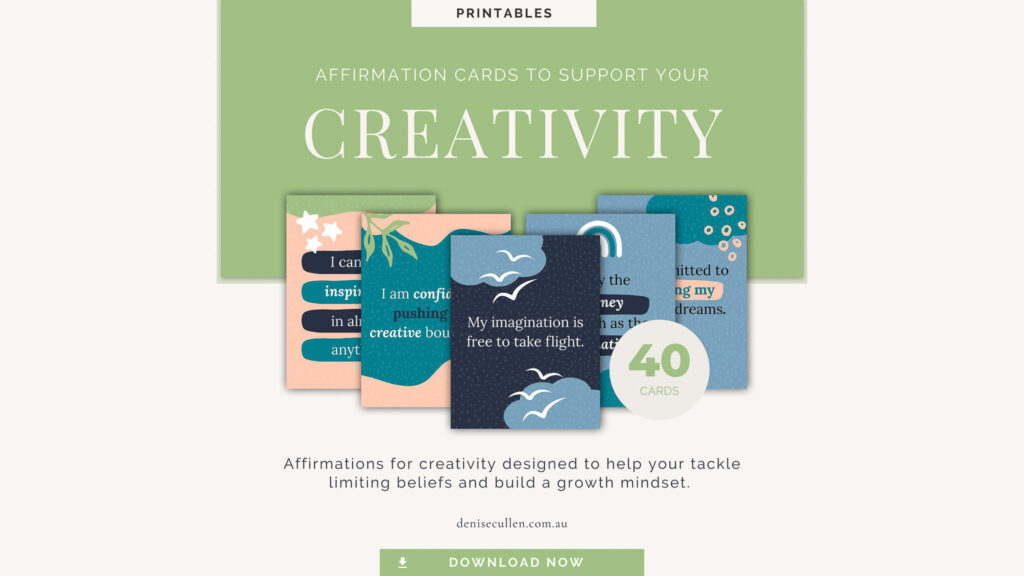
You can craft your own affirmations that speak directly to any specific challenges, goals, values, or barriers to creativity you’ve identified in yourself.
(Better still, subscribe to my newsletter and you’ll receive a discount code with the next issue.)
There are many ways to incorporate affirmations into your writing practice.
You could start each session by writing out three to five affirmations by hand in a dedicated notebook to make them feel more tangible.
You could stick affirmations wherever you’ll see them throughout your workday—on your laptop, mirror, coffee maker, or car dashboard.
Or, when you receive a rejection slip or some other form of disappointing feedback, you could pull out a favourite one or two about your worth, skills and future success.
For creatives, there are many benefits to using affirmations.
They can help counter the self-doubt that accompanies imposter syndrome by reinforcing your legitimate identity as a writer and your right to take up creative space.
By reminding yourself that you’re creative, capable, and allowed to write imperfectly, you can lower the psychological barriers that keep you from putting words on the page.
Affirmations that reinforce your identity as a writer, such as, ‘I show up every day’, helps to cement the behaviours that support your craft.
They can also help you trust your instincts and thus write in your own voice – rather than trying to imitate others or write what you think people want to hear.
As a freelance writer, your mindset is one of your most valuable assets.
The way you talk to yourself shapes how you feel, what you attempt, how you handle setbacks, and ultimately what you achieve.
Affirmations are a simple, science-backed way to ensure your internal dialogue supports rather than sabotages your creative ambitions.
Start today with just one affirmation that resonates with you.
Repeat it when you sit down to write, when doubt creeps in, and when you need a reminder of why you’re doing this in the first place.
Over time, you’ll find that the voice in your head becomes less of a critic and more of a champion.
That shift alone can be a game-changer.
Over to you … What’s one thing it would be helpful for you to hear? Write your own affirmation!
While you’re here … I invite you to subscribe to my newsletter by clicking this link. You’ll receive writing tips every fortnight, breaking news on courses currently under development, and a FREE copy of Pitching for Publication, which deconstructs three successful pitches to Australian and international editors.