If you haven’t heard from me in a while, it’s because I’ve got a full-time gig.
Five mornings a week, I put on my psychologist’s hat and walk through the gates of a high-security men’s prison. Five afternoons a week, I stagger back out, wondering where the hell the day went.
(I discussed the financial reasons underpinning this decision here.)
Unsurprisingly, the job has put a crimp in my travel writing career.
I’m saying ‘no’ to enticing overseas trips because I can’t take a fortnight off; I’m making slow progress on the handful of stories I’m commissioned to write; and I’m not doing much (well, anything) in the way of networking because by the time the evening or the weekend rolls around, I’m already spent.
It got me thinking about how other writers cope with constraints on their time.
Many of us have full-time jobs, or are deep in the thicket of caring responsibilities. Some of us still manage to crank out more than the occasional story, social media post, or pitch.
From what I’ve observed, it seems to come down to shifting two things – your relationship with writing and your relationship with working.
Here are some strategies I’ve found helpful as I navigate this new way of working:
Change your relationship with writing
Writing can be a deeply intuitive process, but that doesn’t mean you always have to approach it in the same way every time.
Changing how you tackle writing tasks can enhance resilience and boost your creativity.
Put boundaries around small blocks of time.
There’s never a good time to write. There’s only the time you decide to protect.
Waiting till you have a free morning, afternoon, or evening means you’ll never write a word.
Instead, seize those (much) smaller blocks of time and watch your words accumulate over the week, month and year.
The trick is to find the time of day that best suits your own energy levels.
Many suggest writing for 1-2 hours before your day job begins, when you’re feeling fresh, and the day job isn’t pulling you in a dozen different directions.
That doesn’t work (at least, not for me).
When I rise early, I spend most of my time stumbling around in a still-sleepy stupor, and don’t get anything done.
Two other times of day yield better results.
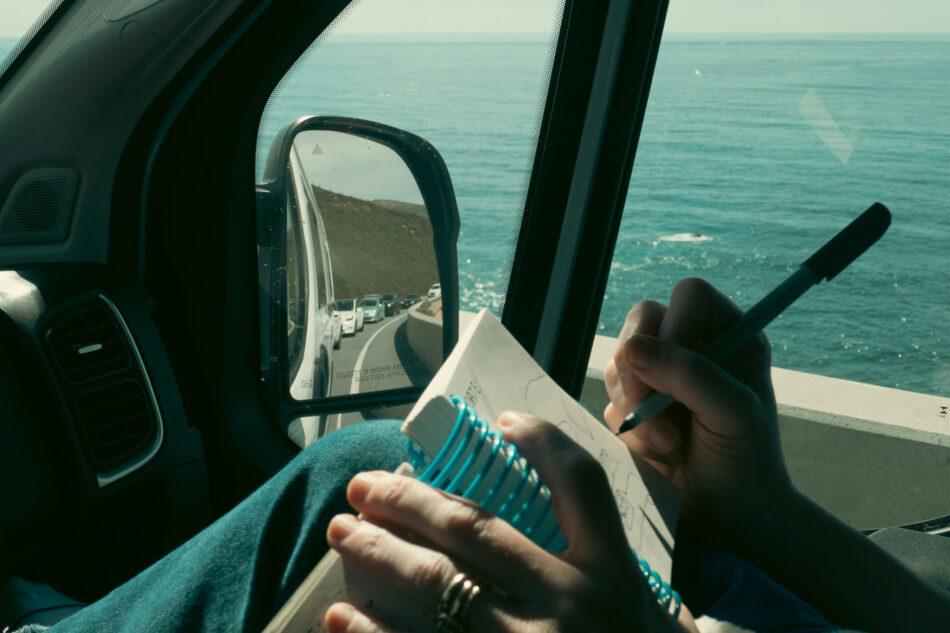
The first is straight after work, when I pull out a notebook I keep in the glovebox of the car, and spend 5-15 minutes free writing – processing (deidentified) interactions, documenting observations, capturing fragments of dialogue, formulating questions.
This practice also functions as a transitional ritual – a way to decompress and leave the horror of the day behind.
The next best time is in the hour before lights out, when the dishwasher is whirring away, the dog is dozing, and there are no other demands on my time.
Novelist Christina Consolino reports writing in 15-minute blocks after she became a caregiver for her mother, who was diagnosed with Alzheimer’s.
“I’ve written in ER bays, doctor’s offices, auto repair lobbies, the car (when someone else is driving!), my mom’s room, the dining room at the memory care facility, and more,” she writes.

Write imperfect, messy, misspelt prose.
When you’re short on time, with a deadline’s looming, it’s tempting to roll writing and editing functions into one. I’ve done it too.
But conflating these two very different tasks is the fastest way to get bogged down in a state of writer’s block.
Lower the stakes. During daily writing sessions, everything counts. All that imperfect, messy, misspelt prose counts. Journalling counts, rough drafts count, fragments count and responding to writing prompts counts.
This is how to stay in the practice even when time is tight.
Polished work will inevitably emerge from that raw material later.
Freewriting like this sidesteps the fussy, fretting internal editor. (For more on freewriting, read this.)
Natalie Goldberg built her whole teaching method around the idea of writing fast, keep going, don’t cross out, don’t worry about grammar, just go, go, go.
Your inner critic operates on a lag – outrun it and you get that much closer to unfiltered thought, which is looser, truer and much more ‘alive’.
Steal the paper-thin margins of the day.
I envy people who can take the train to work and use that as writing time.
As someone who has to drive to work, I can’t just scribble my thoughts down as I go, and I haven’t yet mastered the arts of voice memos or dictating prose out loud.
But there are other margins of the day that I can scrape.
I can jot down a sentence while waiting for the office kettle to boil.
I can commandeer the 10 minutes that other staff use to walk to the prison cafeteria. (I always bring my own lunch.)
I can knock out 200 words over mandated rest pauses or lunch breaks.
Outside of work, I can jot notes on my phone while I’m waiting in line at the supermarket, post office or doctor’s surgery.
Thinking time counts, even if you don’t write a word.
Toni Morrison, author of the Pulitzer Prize-winning Beloved, has talked about composing lines mentally before she ever sat at a desk and then feeling compelled to get the words down by whatever means possible.
The biggest risk for a time-poor writer isn’t burnout — it’s drift.
‘You lose momentum. You lose the emotional frequency of the work. You become a stranger to your own story,’ she writes.
‘Keep coming back to it, even if you can only manage five minutes a day.’

Ringfence one longer session each week.
Although the shorter writing sessions do add up over time, nothing feels more luxurious than a longer stretch of full immersion into your chosen project.
So, once a week, at a time that suits you, set aside 3-4 uninterrupted hours to write.
(Sunday afternoon or evening tends to work for me.)
Although you might yearn for a full day, or even a full week, there are sound reasons why trying to shoehorn a longer session into an already jam-packed schedule can be a recipe for failure.
Oliver Burkeman, author of Four Thousand Weeks and The Antidote, suggests that no-one can do work that demands serious mental focus for more than 3-4 hours a day.
Working for longer, he argues, doesn’t boost productivity because the law of diminishing returns kicks in.
Just guard those 3-4 precious hours, he suggests in his blog.
“Drop the perfectionistic notion that emails, meetings, digital distractions and other interruptions ought ideally to be whittled away to practically nothing,” he writes.
Draw a boundary around the shorter time block and abandon the rest of the day to the usual scatter and chaos.
Remain vigilant against distractions which seek to sabotage your block of deep focus, adds Gary Keller, author of The One Thing.
Build a bunker – that is, find somewhere to work “that takes you out of the path of disruption and interruption”.
Stock up on any snacks or supplies you might need, turn off digital distractions like email and mobile phone, and enlist support.
“Tell those most likely to seek you out what you’re doing and when you’ll be available,” he writes.
“It’s amazing how accommodating others are when they see the big picture and know when they can access you.”
Can’t find time to write? Read.
Australian model Elle Macpherson once famously stated, “I don’t think you should read what you haven’t written.”
Off the catwalk, though, you can’t be a writer without first being a reader.
There will be days you really can’t summon the time, motivation or inclination to write.
This is the perfect time to opt for a writing-adjacent activity like reading or listening to an audio book.
Reading can keep a writer’s flame alight when writing itself feels impossible.
Annie Dillard, author of The Writing Life, says that reading shows a writer what’s possible on the page.
Ray Bradbury, in Zen in the Art of Writing, also urged writers to read constantly and widely — poetry, essays, fiction, anything – to stock the well that writing later draws from.
John Dufresne, author of Is Life Like This? adds that it’s not enough just to read the things you like.
“A writer has to read everything from Wittgenstein’s Philosophical Investigations to the backs of cereal boxes,” he wrote.
Change your relationship with working
There are many aspects of working full-time that I loathe – commuting, constant interruptions, office politics, and not having access to a mobile phone among them.
But the most productive shifts have been around my mindset in relation to work.
Focus on the benefits that work brings
Once I stopped stewing in resentment about everything the day job stopped me doing, the very real financial and other benefits began to accrue.
Writing without the gnawing anxiety that comes from not knowing when you’re next being paid means that I can take greater risks, and work only on projects that fascinate me.
(Accounts payable departments at various media outlets might have also noticed a sharp decline in the amount of sarcastic correspondence I send their way.)
Knowing I have money going into my bank account each fortnight also gives me greater agency.
If there’s an experience I want to road-test, a domestic flight I want to take, or a restaurant I want to include in a story, I don’t need to bow and scrape to PRs and hosts and assorted others holding the purse-strings. I can just do it. Quickly. Without a lot of stuffing around.
And without any obligation or awkward conversation if it turns out to be a dud.
At first, I railed against sacrificing precious writing time for money.
Now, I see it as buying time to write without financial panic.
This was a psychological shift worth making.
Pick projects that match your time constraints.
Travel writing and full-time work go terribly together, but not as terribly as you might think.
Instead of long-haul flights to far-flung destinations, I’m focussing on snackable travel close to home.
No airport queues, no flight delays, no jetlag, no lost luggage.
Aside from sheer necessity, this approach was inspired by travel content creators twothewonder who recommend 9-to-5ers follow a ‘three-hour rule’ – taking a weekend to create content about attractions within an easy three-hour drive from home.
For a list of other compelling reasons to focus on stories close to home, read this.
Tweaking the sort of work you do might also involve changing your preferred approach or form.
For instance, a novel might be the wrong project right now.
Essays, short stories, columns, newsletters, or other forms that can be completed in weeks rather than years are better suited to time-starved writers.
Jo Mazelis explained how time constraints were one of the factors that pushed her towards telling short stories rather than novels.
Meanwhile, K. A. Doore tells Uncanny Magazine that new parenthood destroyed her daily word-count goals and other aspects of her writing process, forcing her to become more experimental and improvisational.
The key is to make the constraints work for, not against, you.

Ruthlessly cull timewasters.
Removing timewasters from your week can hand you back a big chunk of time.
Writing is deep, sustained-attention work that gets destroyed by fragmentation – those unbilled hours lost to tasks like inbox triage or social media scrolling.
Checking, reading and responding to email chews up around 2 hours of the average knowledge worker’s day.
According to Missive, each time a notification pulls you into your inbox, you pay a 15-minute ‘context-switching’ cost to get back on track.
The collaborative team inbox and chat app company recommends setting aside time for 2 or 3 dedicated email sessions during the day.
Spelling that out in an autoresponder (“I check email at 10am and 2pm”) can reset expectations for senders.
I do acknowledge, though, that it’s difficult to ignore an email with the Subject line of “Maldives?”
Then there’s Facebook, Instagram, TikTok and the like. Research reveals that over a billion people spent an average of 3 hours scrolling through social media in 2020.
Dopamine scrolling can be an especially insidious trap for writers who are now also expected to promote themselves on social media on top of everything else.
I’ve definitely told myself ‘I’m just checking analytics on my last post’ and suddenly find I’ve spent two hours scrolling through videos of cattle dogs behaving badly.
With daily streaming time spent on Netflix now around 2.4 hours per day, mindless entertainment can be another big drain.
It can be a hard truth to hear, but you’re currently filling your time with something less important than writing.
Find it and be surgical about removing it – or at the very least shrinking it.
Treat everything as material
Nora Ephron, author of I Remember Nothing, once said, “Everything is copy”.
Even if you’re in a job which has nothing whatsoever to do with your creative work, small fragments will naturally make their way into your words – the exact rhythm of a night shift, the precise vocabulary of a trade, or the small human movements only an insider would notice.
Lived experience carries an authority and specificity that simpler research cannot fake.
During my grimmest days behind bars, I think of Franz Kafka, author of The Metamorphosis.
He spent his working life as an insurance claims officer, assessing workplace injuries.
The bureaucratic dread, absurd hierarchies, and mindless institutional power in his fiction are recognisably drawn from that office.
(I can relate.)
One benefit of being a writer is that nothing is ever wasted.
Everything we encounter could find a second life on the page. So, keep a running notes document, or voice memo app, or old-fashioned notebook at the ready to jot down the next gem.
Keeping writing projects top of mind can be a real struggle.
But, if you do, you’ll always find new ways to feed them, no matter how under-the-pump you are.
While you’re here …
Want more no-BS insights into the writing life – both travel and beyond? I invite you to sign up for my semi-regular newsletter. As a thank you, you’ll also receive my FREE 5-day writing course called Unlock Your Creative Flow. One email, once a day, for five days, plus a follow-along workbook containing further space for reflection.